How to Choose a Laptop for 3D Modeling
A hardware guide to choosing a laptop for 3D modeling: graphics card, processor, RAM, SSD storage and the software you plan to run.
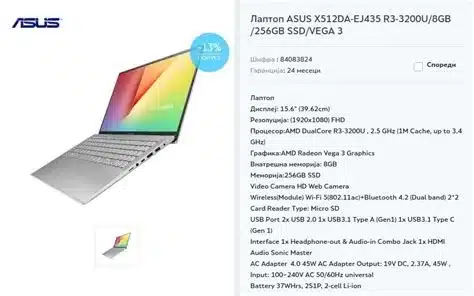
3D modeling has grown in popularity in recent years and is now used across many industries, which is why choosing a laptop for 3D modeling matters so much. For anyone who wants to do 3D modeling, one of the most important pieces of equipment is a suitable laptop. So which features should a laptop for 3D modeling have?
In this article, we explain how to choose a suitable laptop for 3D modeling and which hardware specifications you need. We also cover the best graphics cards, processor features, software and memory and storage requirements. If you want to do 3D modeling and are looking for a suitable laptop, it is worth reading this article carefully to choose the right hardware. Let’s learn together how to choose the ideal laptop for 3D modeling.
How to choose a laptop for 3D modeling
There are a few important factors to consider when choosing a laptop for 3D modeling. First, the quality of the graphics card is very important. Having a good graphics card is vital when working on high-resolution 3D modeling projects. Processor speed is another important factor. Because 3D modeling uses the processor intensively, strong processor performance is essential.
Memory and storage are other criteria not to forget. With enough RAM and storage, you can run and store your projects without problems. Portability may also matter, so weight and size should be considered when choosing a laptop. Finally, do not overlook software compatibility. It is important to check whether the 3D modeling software you plan to use is compatible with the laptop. Taking all these factors into account, you can choose the laptop that best fits your needs and budget.
Choosing a laptop for 3D modeling is an important decision that can affect the efficiency and quality of your projects. With a laptop that has the right technical specifications, you can work more efficiently, render faster and take on more complex projects. That is why it is very important to research thoroughly and choose the one that fits your needs.
When choosing a laptop for 3D modeling, you should also keep your budget in mind without compromising on technical specifications. Compare different brands and models and read expert and user reviews to make a better-informed decision about the laptop that best suits your needs.
What is the best graphics card for a 3D modeling laptop?
When choosing a laptop for 3D modeling, which graphics card is best?
There are a few key factors to consider when choosing the best graphics card for 3D modeling. Memory capacity, processing speed, data transfer speed and the cooling system are among the most important.
Memory capacity: The graphics card’s memory capacity is very important when working on high-resolution, detailed 3D modeling projects. Choosing a graphics card with at least 4 GB of memory will give you a performance advantage.
Processing speed: The graphics card’s processing speed is also a critical factor for 3D modeling. A graphics card with high processing speed lets you render your projects quickly.
Data transfer speed and cooling system: Data transfer speed lets you move quickly between files during 3D modeling. An effective cooling system on the graphics card also prevents performance loss during long sessions.
What processor features does 3D modeling require?
Choosing the right processor is very important for 3D modeling projects. These projects require high processor speed and strong multi-core performance. At least a quad-core processor should be preferred.
Memory speed, memory type and memory capacity are other factors to consider when choosing a processor. For large-scale 3D modeling projects in particular, at least 16 GB of RAM is required.
The processor’s cooling system is also very important for performance. Overheating can occur during intensive processor use, so a processor with suitable cooling should be preferred.
Finally, the balance between processor and graphics card is very important for 3D modeling projects. When choosing a processor, make sure it is well matched with the graphics card’s specifications.
The best software for 3D modeling
The best software for 3D modeling includes Blender, Autodesk Maya, Cinema 4D and ZBrush. These programs are popular for 3D modeling projects because they can be used in different fields and have user-friendly interfaces. Blender in particular remains popular for being free and easy to use, while Autodesk Maya is preferred by professional users for its wide range of features.
3D modeling software also includes extra features such as rendering and animation, which will influence your choice depending on your project’s requirements. ZBrush, for example, is preferred especially for detailed modeling, while Cinema 4D excels at animation.
Because 3D modeling software is updated regularly, it is also worth researching the latest version that suits your project’s requirements. This way, you can raise the quality of your project by using software with the newest features and best performance.
In short, the best software for 3D modeling will vary with your project’s requirements, your budget and your experience. However, Blender, Autodesk Maya, Cinema 4D and ZBrush are generally among the most popular thanks to their wide range of features and user-friendly interfaces.
Memory and storage requirements for 3D modeling
When doing 3D modeling, having enough memory and storage is extremely important. You need enough space to process and store large 3D files. That is why at least 16 GB of RAM is required for 3D modeling. A high-capacity SSD should also be preferred for fast data transfer and storage.
When using a laptop for 3D modeling, high read and write speeds are very important so files can be written and read quickly. That is why an SSD of at least 500 GB should be preferred. An external hard drive with enough space is also needed to back up 3D modeling files.
Memory and storage requirements for 3D modeling are very important for an uninterrupted experience when working with large files. Investing in high-capacity, fast storage solutions will help 3D modeling projects run efficiently.
Having the right memory and storage when choosing a laptop for 3D modeling will help you manage your projects efficiently. By investing in high-capacity RAM and an SSD along with external storage devices, you can manage the 3D modeling process more effectively.


