Architecture Competition Renders: Images and Boards That Win the Jury
How competition renders and boards work together: which image tells the jury what, how to lay out the board and what to check before you submit.
You spend weeks on an architecture competition, yet the jury reads all that work from a handful of boards. However strong the idea, a crowded board or an image that doesn’t say anything clear can lose the project among the others. That’s why preparing architecture competition renders and boards is not the final decoration of a design; it is the story itself. In this article we explain what each image tells the jury, how to build the board and what to check before you submit.
How does a jury look at a board?
Jury members review a large number of entries in a short time. In the first round, the time spent on each board is limited, so the board has to state one idea clearly at first glance. A good competition presentation quickly answers three questions: What does the project propose? How does the idea respond to the site and the brief? What will the space look like when it is lived in?
A render answers the third question, but it is not enough on its own. It gains meaning when it is read together with the concept diagram, the site plan, plans and sections. If that link between image and drawing is missing, the jury sees a nice picture but doesn’t understand the project.
Architecture competition renders: what does each image communicate?
The hero render
This is the image in the largest, most visible area of the board. It is chosen from the angle that best explains the project’s idea: its relationship with a square, a decision about the facade or the way light behaves inside. One hero image is stronger than four images of the same size.
Aerial and context views
In urban-scale competitions, these show how the scheme relates to its surroundings. They need to be read with the roads, green spaces and neighbouring buildings. We cover this in detail in our article on aerial architectural rendering.
Eye-level and close-up views
These show how the space is experienced at human scale. A close-up explains decisions about materials, details and light. Used together with the hero image, the project reads both as a whole and in detail.
Atmosphere or photorealism?
Not every jury expects the same visual language. In ideas competitions and academic juries, simple or atmospheric images that bring the concept forward can stand out; in competitions led by investors or clients, realistic images that show buildability often make more sense. Reading the brief and finding out who sits on the jury is the first step in choosing a visual language.
Plan your renders together with the idea
During a competition, the images are often left to the end and squeezed into the last days. Yet the angle of the hero image can be decided as soon as the design idea becomes clear. Camera angles chosen early show which parts of the model need detail, cut unnecessary modeling and leave time for light and materials in the final week. Sketching a rough board layout at this stage also shows from the start which image will appear at what size and in which frame the idea reads strongest. This way, the renders and the board are not two separate jobs but parts of a single story.

Board layout: hierarchy, white space and reading order
A board is the page layout of a story. The reading order should be clear, and where the eye starts and where it goes next should be designed.
- Fix the format first: The sheet size and orientation in the brief should be settled at the start. If the orientation changes later, the whole layout has to be rebuilt.
- Use a grid: When images, drawings and text sit on a shared grid, the board looks orderly and professional.
- Build a hierarchy: Title and idea statement, the hero image, then plans, sections and diagrams. Each element grows or shrinks by importance.
- Design the white space: Filling every empty area makes the board crowded. White space lets what matters stand out.
- Cut the text: Use short headings and diagram labels instead of long descriptions; the detail can go in the report.
- Choose one visual language: The colour tone of the renders, the line weights of the drawings and the typefaces should complement each other.
You can also find the general principles of building a presentation in our article how to present architectural projects.

Build the boards faster: Presentation Studio
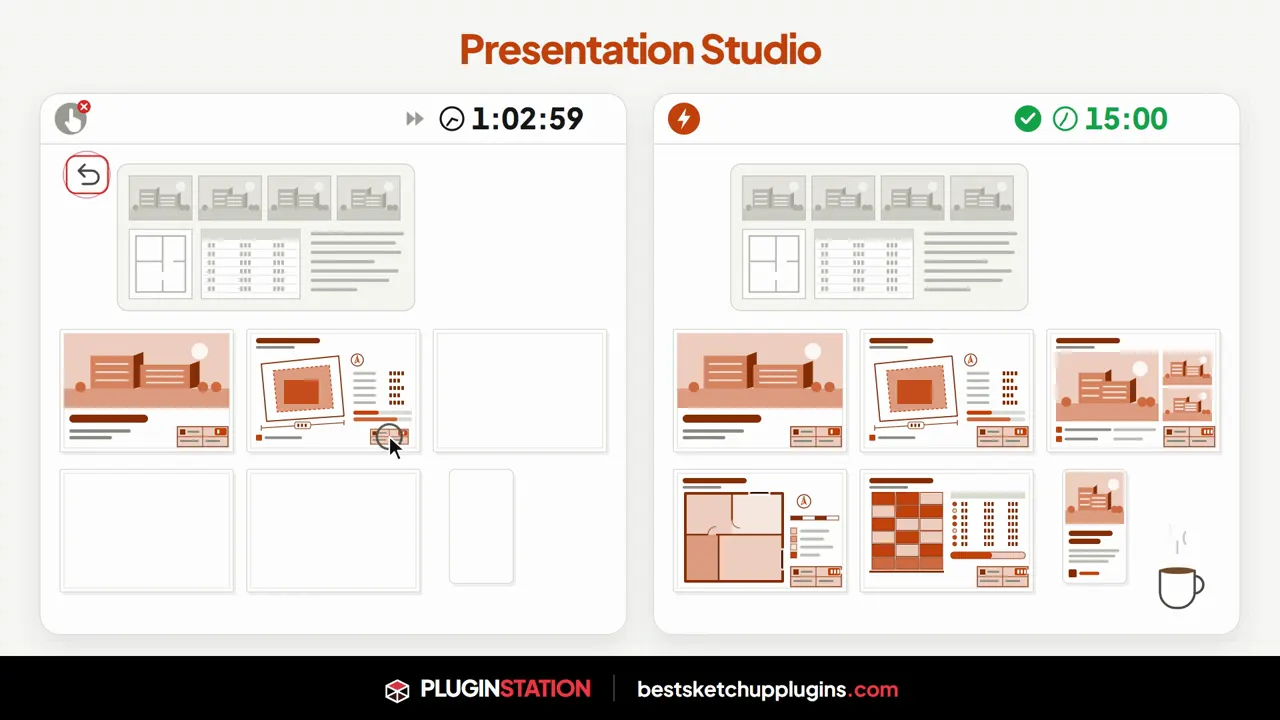
In the week of submission, much of the time goes into laying out pages by hand. The free Presentation Studio places your renders and plans into four sheet-style templates with a title block, sheet numbers, figure numbers and a north arrow. It runs in your browser, exports PDFs for 16:9 screen, 9:16 phone, A4 and A3, and your project stays on your device. The tool is currently in beta. If the brief asks for a sheet size outside these formats, you will need to finish the final layout in your own software.
Pre-submission checklist
- Are the images high enough in resolution for the print size? An image that looks good on screen can turn blurry in a large print.
- Is there any noise or grain left in the renders? Zoom in on the dark areas to check; we explain the causes in our article on render noise.
- Have you followed the anonymity rule? If the brief forbids names, logos or identifying marks, no trace should remain in the corners of images, in file names or in PDF properties.
- Are the scale, north arrow and drawing titles complete?
- Look at the board from a few steps away and at a reduced size to make sure the idea still reads. Showing it to a colleague before submission surfaces what you have missed.

Frequently asked questions
How many renders should a competition board have?
There is no fixed number; the brief and the number of boards decide. The general principle is that one strong hero image supported by a few smaller images reads better than many images of the same size.
Do competition renders have to be photorealistic?
No. The visual language is chosen according to the jury and the purpose of the competition. What matters is that the image conveys the idea accurately and consistently.
Does outsourcing renders break anonymity?
Getting visualization support is common, but you should read the brief’s rules on this and make sure no signature or logo remains in the submitted files.
Do you have renders that need to meet a competition deadline? Browse our architectural visualization projects or send us your drawings on WhatsApp; we’ll get back to you based on scope and deadline.